
Friday, March 6, 2009
Footprints in the Sand
One night I dreamed I was walking along the beach with the Lord.
Many scenes from my life flashed across the sky.
In each scene I noticed footprints in the sand.
Sometimes there were two sets of footprints,
other times there were one set of footprints.
This bothered me because I noticed
that during the low periods of my life,
when I was suffering from
anguish, sorrow or defeat,
I could see only one set of footprints.
So I said to the Lord,
"You promised me Lord,
that if I followed you,
you would walk with me always.
But I have noticed that during
the most trying periods of my life
there have only been one
set of footprints in the sand.
Why, when I needed you most,
you have not been there for me?"
The Lord replied,
"The times when you have
seen only one set of footprints in the sand,
is when I carried you."
Mary Stevenson

Wednesday, March 4, 2009
Islamic empire
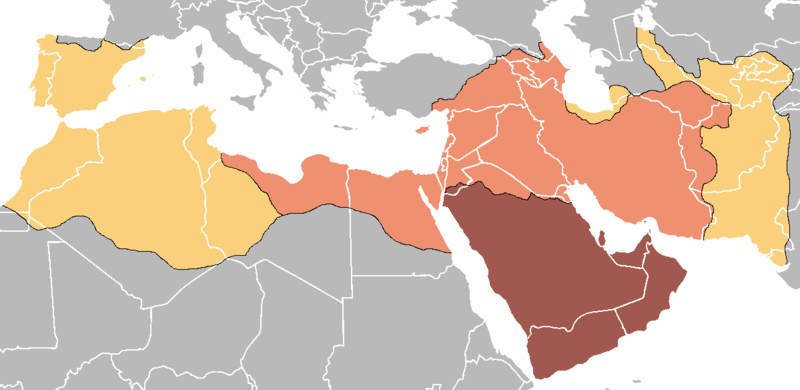
██ Expansion under the Prophet Mohammad, 612-632
██ Expansion during the Rightly Guided Caliphate, 635-680
██ Expansion during the Umayyad Caliphate, 661-750


Ibn Seena
Ibn Seena
Avicenna
From Wikipedia, the free encyclopedia
For the lunar crater, see Avicenna (crater). For the mountain peak, see Ibn Sina Peak.

Abū ‘Alī al-Ḥusayn ibn ‘Abd Allāh ibn Sīnā Balkhi', known as Abu Ali Sina Balkhi[3][4] (Persian: ابوعلی سینا بلخى) or Ibn Sina (Persian: ابن سینا) and commonly known in English by his Latinized name Avicenna (Greek: Aβιτζιανός, Abitzianos),[5] (born c. 980 near Bukhara, contemporary Uzbekistan, died 1037 in Hamedan in modern Iran) was a Persian[6] polymath and the foremost[7] physician and philosopher of his time. He was also an astronomer, chemist, geologist, logician, paleontologist, mathematician, physicist, poet, psychologist, scientist, and teacher. [8]
Ibn Sīnā wrote almost 450 treatises on a wide range of subjects, of which around 240 have survived. In particular, 150 of his surviving treatises concentrate on philosophy and 40 of them concentrate on medicine.[9][10] His most famous works are The Book of Healing, a vast philosophical and scientific encyclopaedia, and The Canon of Medicine,[1] which was a standard medical text at many medieval universities.[11] The Canon of Medicine was used as a text-book in the universities of Montpellier and Louvain as late as 1650.[12] Ibn Sīnā developed a medical system that combined his own personal experience with that of Islamic medicine, the medical system of the Greek physician Galen,[13] Aristotelian metaphysics[14] (Avicenna was one of the main interpreters of Aristotle)[15], and ancient Persian, Mesopotamian and Indian medicine. He was also the founder of Avicennian logic and the philosophical school of Avicennism, which were influential among both Muslim and Scholastic thinkers.
Ibn Sīnā is regarded as a father of early modern medicine,[16][17] and clinical pharmacology[18] particularly for his introduction of systematic experimentation and quantification into the study of physiology,[19] his discovery of the contagious nature of infectious diseases,[20] the introduction of quarantine to limit the spread of contagious diseases, the introduction of experimental medicine, evidence-based medicine, clinical trials,[21] randomized controlled trials,[22][23] efficacy tests,[24][25] clinical pharmacology,[24] neuropsychiatry,[26] risk factor analysis, and the idea of a syndrome,[27] and the importance of dietetics and the influence of climate and environment on health.[28] He is also considered the father of the fundamental concept of momentum in physics,[29] and regarded as a pioneer of aromatherapy for his invention of steam distillation and extraction of essential oils.[30] He also developed the concept of uniformitarianism and law of superposition in geology.[31]
George Sarton, an author of the history of science, wrote in the Introduction to the History of Science:
"One of the most famous exponents of Muslim universalism and an eminent figure in Islamic learning was Ibn Sina, known in the West as Avicenna (981-1037). For a thousand years he has retained his original renown as one of the greatest thinkers and medical scholars in history. His most important medical works are the Qanun (Canon) and a treatise on Cardiac drugs. The 'Qanun fi-l-Tibb' is an immense encyclopedia of medicine. It contains some of the most illuminating thoughts pertaining to distinction of mediastinitis from pleurisy; contagious nature of phthisis; distribution of diseases by water and soil; careful description of skin troubles; of sexual diseases and perversions; of nervous ailments."[20]
Friday, February 27, 2009
Focused! :)
When working on a major project, do you ever find yourself procrastinating? Of course you do! We all do! Whether you have attention deficit disorder or you are a polychrone or you simply suffer from information overload, it can be difficult to keep your mind focused on one project.
What follows is a guide to help you gain control of your focus so that you can make productive progress on your project.
How to Focus
What follows is a guide to help you gain control of your focus so that you can make productive progress on your project.
How to Focus
- Eliminate Distractions. Even one distraction can bring your house of cards down, so be complete about this. This means:
- Clear your desk. If you need to, clear it all off into a pile on the floor to deal with after you are done.
- No internet or computer programs open that are unnecessary for your project.
- No TV or Radio unless it is instrumental or unless you are doing art work and you work best with music.
- No noise. If you have other people nearby that make noise on a regular basis, consider getting a pair of noise canceling headphones.
- No phone. That's what voice mail and caller id are for. Don't answer it. If you think it might be important you can listen to the voicemail and decide when will be the best time to call back. Imagine that you are in a meeting and can't be interrupted.
- No email or feed reader.
- Just you and your project.
- Clear your desk. If you need to, clear it all off into a pile on the floor to deal with after you are done.
- Visualize Take 5-10 minutes to visualize your project and what you need to do overall and today.
- Planning Write out the plan for your project whether it is to clean the house, design a website, complete a writing assignment, create art, complete a day of errands, studying for an exam, or whatever. Write out the major steps from start to finish in a basic outline format.
- Today Plan Write out the action steps you will take today and the approximate time you will be working on each step. Be as granular in your outline as need to keep yourself on task, but not any more than is necessary.
- Breaks & Rewards Build in breaks into your Today Plan. Write in the times and use a timer to stay on track. Here is a free online timer. Plan a reward for the end of the day.
- Take Action Work your plan. Use your Today Plan as your guide. Keep moving forward. When you find yourself getting distracted go back to your Today Plan. Be strict with yourself about keeping distractions from creeping into your project time.
- Creative Projects If your project requires creativity, staying focused can be extra challenging. Here are some tips specifically for this:
- Writing: Write your outline and then just start writing. Don't be afraid of a bad first draft. Once you have that then you can edit into a masterpiece. The first draft is most difficult. The editing is much easier. If you get totally stuck then you probably need either more time, more information, or a break. Figure out which. You may also need to re-examine the assignment. Walking and/or meditation breaks (with closed eyes) are very helpful.
- Arts: Get your "rough draft" in place: sketching, outlines, basic form, etc. For certain types of art such as logo design, it is good to do many iterations to get the right one. Make sure you understand the assignment well. Look at it from different angles to help get your creativity flowing.
- General: Remember to slow down. Nothing stifles creativity more than trying to rush it. And remember to have fun. Even if it is not a "fun" project, find ways to make it fun and things will move along easier for you.
- Savor a Reward When the day is over and you've done your best, look back and recognize your accomplishments. Plan for tomorrow and then let it go for the rest of the day. Enjoy the reward you promised to yourself even if it is as small as a nice cup of tea while you relax quietly for 15 minutes before dinner.
Tuesday, February 24, 2009
Monday, February 23, 2009
Subscribe to:
Posts (Atom)